

In the contemporary healthcare landscape, the concept of professional development is undergoing a radical metamorphosis. We are no longer facing a mere bureaucratic requirement, but a true strategic asset for patient safety and the resilience of the national health service. With the launch of the new 2026-2028 training triennium, the continuing medical education (CME) system is evolving, integrating new technologies, stricter ethical criteria, and a close correlation with legal protection.
1. The 2026-2028 triennium: beyond credit counting
The training requirement of 150 credits for the new triennium is part of a framework of reforms that reward planning over urgency. The real novelty is the consolidation of the individual training dossier: a tool that not only allows for a personalized growth path but also guarantees a credit bonus (up to 30 credits) for those who demonstrate consistency between the skills acquired and their professional profile.
Training is no longer an isolated event, but a biological continuum of clinical activity.
2. The training shield and the Gelli-Bianco law
A topic of paramount relevance for 2026 is the reinforcement of the link between CME compliance and insurance coverage. According to the latest provisions, the effectiveness of professional liability insurance policies is subject to fulfilling at least 70% of the training obligation.
Being “compliant” with credits is no longer just a matter of badges, but an essential financial and legal protection. In a context of growing medico-legal litigation, competence certification becomes the professional’s first line of defense.
3. Technological innovation: simulation and artificial intelligence
The year 2026 marks the end of the distinction between residential and digital training. Thanks to resolution no. 10/2026, activities based on high-fidelity simulation and virtual reality (VR) enjoy equal, if not superior, recognition compared to traditional lectures.
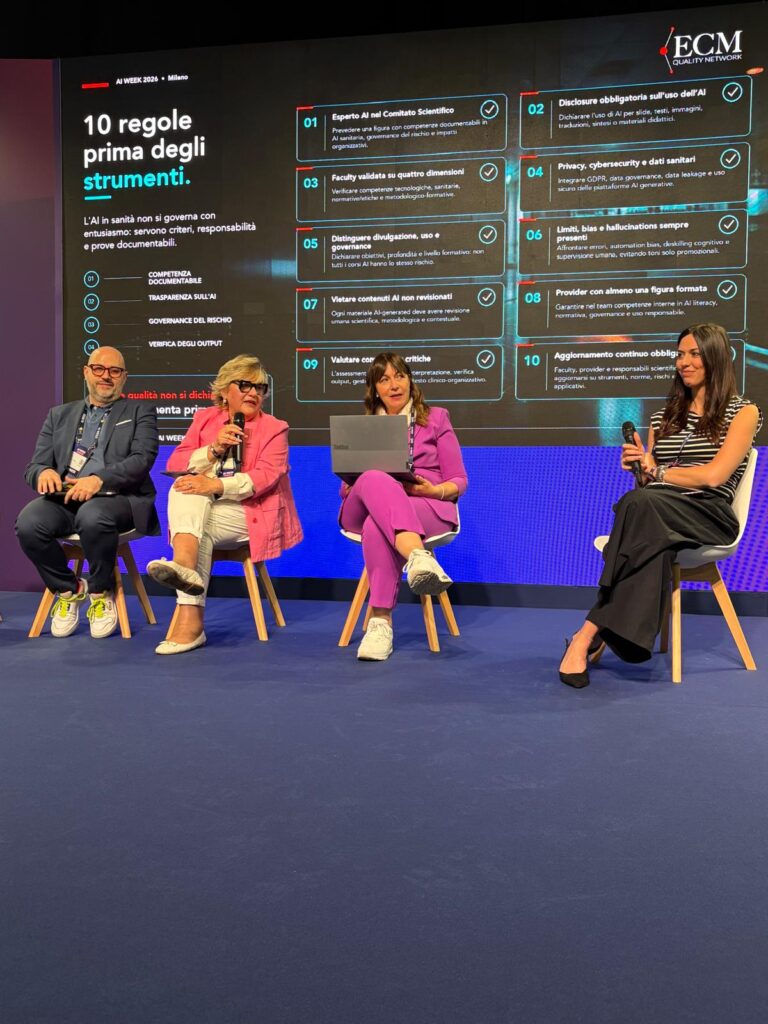
The integration of artificial intelligence as both a subject of study and a learning method now makes it possible to:
- Analyze complex clinical cases in controlled environments.
- Reduce human error through repeated practice.
- Monitor learning effectiveness in real time.
4. Quality and governance: the role of standard providers
With the new monitoring network coordinated by AGENAS, the distinction between providers will become increasingly sharp. Scientific quality, independence from commercial influences, and the clinical impact of courses are the new evaluation parameters.
National providers such as Meet and Work act as guarantors of this process, transforming training into a high-profile experience that combines scientific rigor with organizational flexibility.
The challenge of the future
The 2026-2028 triennium is not a simple deadline, but an opportunity to redefine the identity of the healthcare professional. The question every practitioner must ask themselves is no longer “How many credits am I missing?”, but “What skills do I need to manage change?”.
The future of healthcare depends on certified, ethical, and technologically advanced knowledge.