
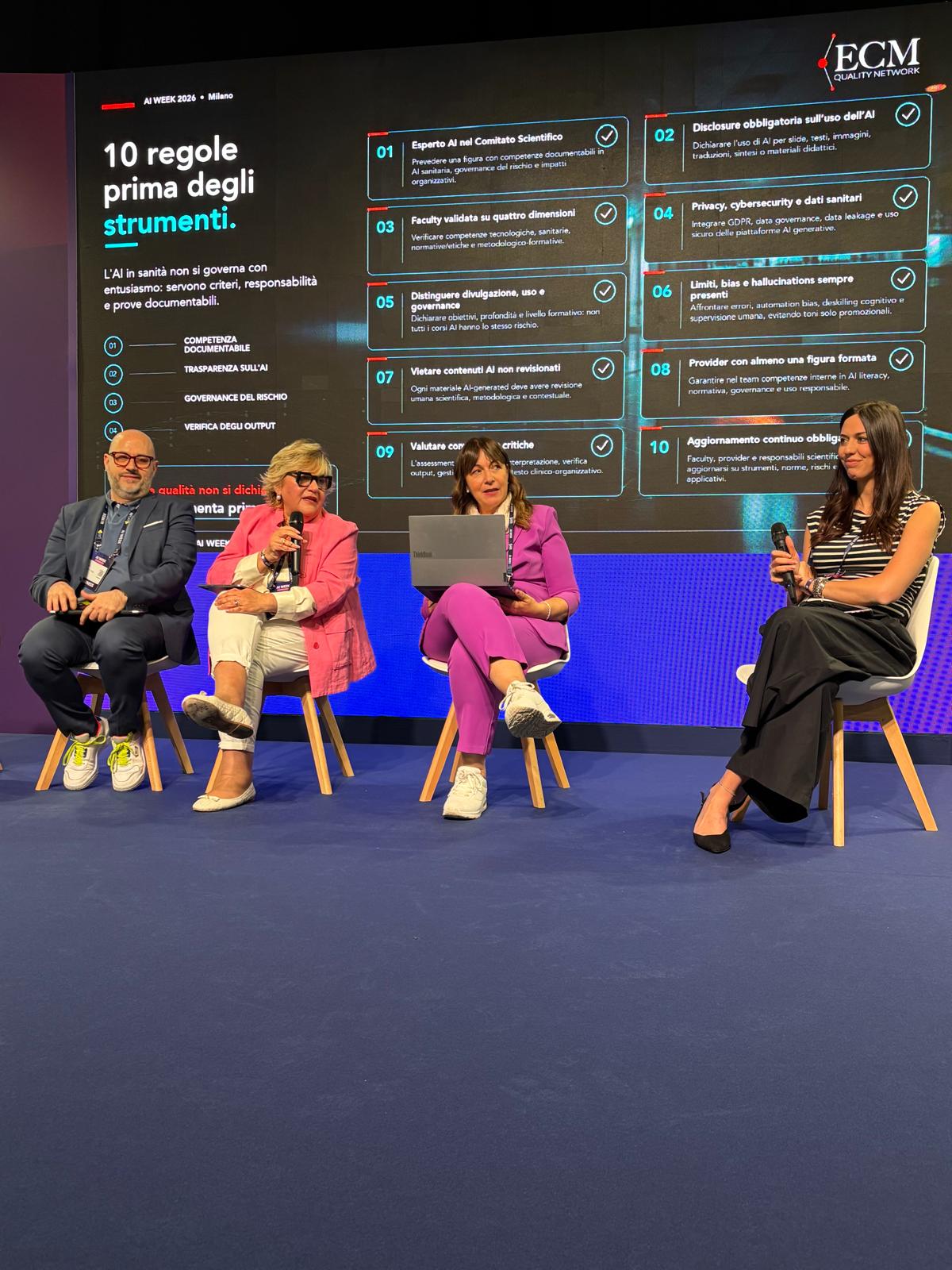
At Milan’s AI Week 2026 — Europe’s largest event dedicated to artificial intelligence — ECM Quality Network, of which Meet and Work actively participates with a role on the board of directors, took the stage with a deliberately provocative speech titled: “Prompt Rescue – AI is running. Is the healthcare system ready to govern it?” Together with Dr. Lorena Martini from Agenas, the objective was not technical dissemination nor presenting new tools. It was to address a deeper and more urgent question: who governs the change that AI is bringing to the healthcare system?
Healthcare Is Already AI-Blended
Let’s start from a reality check that too often is still underestimated: artificial intelligence is not a phenomenon of the future. It is already present in wards, in clinical reports, in decision-making processes. Often without being declared.
We are not talking about futuristic scenarios or cutting-edge trials. We are talking about tools already integrated into the daily workflows of doctors, nurses, administrative staff, and trainers. Technology has become an operating environment, not an option.
In this context, the crucial question is no longer whether AI will enter healthcare. It has already entered. The question is who will be able to govern it, defining its criteria, responsibilities, and limits. And here emerges the first structural problem: the technology adoption curve runs much faster than regulatory criteria. The system finds itself chasing a transformation that has already changed the rules of the game.
This is confirmed by the data presented at AI Week 2026: out of 1,100 healthcare professionals analyzed by the National Forum for Digital Health, only 12% concretely use AI tools, while over 50% of active doctors have not yet integrated them into clinical practice.
The great misunderstanding: using does not mean understanding
One of the strongest points emerging during the speech concerns a misunderstanding that risks becoming systemic: confusing familiarity with a tool with real competence in handling it.
Using artificial intelligence has become simple, fast, almost natural. This is exactly the problem. Ease of use generates a false perception of mastery. One learns to interact with the tool, but not necessarily to critically evaluate its results.
AI produces plausible, well-constructed, convincing answers. But plausible does not mean reliable. The validation of an output — the ability to recognize when an answer is correct, partial, or simply wrong — remains an exclusively human responsibility. And this responsibility requires competencies that are not acquired by using a tool, but by studying it, understanding its mechanisms, limitations, and biases.
The most insidious risk for healthcare is not the machine’s technical error. It is the validated error: the one that the professional accepts, relays, normalizes. When a healthcare system learns to consider a misinterpreted error as normal, that error stops being an isolated incident and becomes operational culture. It is at that point that the damage becomes structural.
Who can reallytrain on AI in Healthcare?
The massive introduction of AI in healthcare processes compresses decision-making times and generates information overload that risks progressively eroding professionals’ critical sense. In this scenario, training is not an accessory: it is a strategic safeguard.
But training on AI in healthcare is not a task that can be entrusted to anyone familiar with technology. A multidisciplinary faculty is needed, capable of bringing together healthcare, ethical, governance, and real AI literacy competencies. Someone is needed who knows how to translate technology into responsible clinical decisions, who knows the application contexts, and who can accompany health professionals in a critical learning journey — not just operational. In this framework, the role of ECM providers does not change in substance — we are already guarantors of quality and responsible for training programs and content — but it is significantly strengthened. The arrival of AI amplifies this responsibility: at a time when the system risks being flooded with unvalidated content, being the custodians of training rigor, documentability, and continuous updating is no longer just a regulatory requirement. It becomes a cultural safeguard.
A signal in this direction came precisely during AI Week: Meduspace promoted the first accredited ECM course in the history of the event, demonstrating that structured training on AI in healthcare is already possible — and urgent.
The Position Paper and the 10 Golden Rules
ECM Quality Network is working on an institutional Position Paper to bring the topic of AI training regulation to decision-making tables. A document that wants to be a concrete contribution to the debate, not a theoretical exercise.
In the meantime, during the speech, the 10 Golden Rules for AI Training in Healthcare were presented — a practical framework designed to guide those who design and those who deliver training in this area. Among the fundamental principles:
Documentable competencies: AI training must produce concrete evidence of learning, not mere exposure to tools.
Mandatory disclosure: Every training content using texts, images, or materials generated by AI must explicitly declare it.
Risk governance: No AI-generated content must be used in training contexts without critical review by a qualified human professional.
Continuous updating: Those who train must know the limitations, biases, and hallucinations of AI systems, and systematically update as they evolve.
These are not restrictive rules. They are the minimum conditions for serious training in a context where the consequences of an error are not a wrong grade, but a clinical decision.
Navigate or endure: the choice is already now
Governing AI in healthcare is not a technical issue. It is an organizational, cultural, and political choice. It requires investment, vision, and the willingness to face a complexity that is not solved by adopting the newest tool on the market.
The revolution is already underway. Healthcare systems that choose to navigate — building competencies, defining responsibilities, investing in rigorous training — will have the tools to guide change. Those that wait will endure it, adapting to logics decided elsewhere, with timelines and criteria that do not belong to medicine.
AI does not wait for the system to be ready. It is already up to the system to act quickly — and do it well.